Ambizione Reflections

At the end of 2025 my SNSF Ambizione grant came to an end, slightly prematurely, after three and a half years. I thought this would be a good occasion to reflect a bit on how I got this grant, what it did for me/ my career and some thoughts about the future of this funding scheme in the face of a changing funding landscape and shrinking budgets.
First things first, what is an Ambizione Grant:
Ambizione grants are aimed at early career researchers who wish to conduct, manage and lead an independent project at a Swiss higher education institution. (from SNSF Ambizione )
For me this meant 4 years of funding, which included my full salary as well as 400,000 CHF of research budget. A part of this research budget can be used to employ a PhD Student, which at Swiss PhD salary rates comes just shy of 200,000 CHF total for the 4-year duration of a PhD degree. I will not try to talk this part down, this is very generous funding, providing a formidable kickstart to your independent scientific career. In order to apply for an Ambizione, you need a PhD, a certain amount of experience, a unique and novel research idea, and a host group/university.
Now finding a suitable host group is not as straightforward as it sounds (at least it was not for me). Back in 2019 when I was first gearing up to apply for this grant, I reached out to the most logical host for the sort of research I was planning to do and was promptly rejected. I then reached out to three other Professors in Switzerland and during a busy Summer visited all three of them in August of 2019. All of them were extremely generous with their time and offered to host me, but all three of them also had a severe lack of available lab space, which of course would be good to have if you want to start your own research group. After some deliberation and based on a variety of factors I chose to go with Prof. Jean-Louis Reymond at the University of Bern. With the benefit of hindsight, this was probably the best possible decision I could have made. Both Prof. Reymond and the Department in Bern were nothing but amazing and supportive for my start in and later departure from Bern, so a big thank you already here.
At the end of November 2019, I submitted my Ambizione Grant application. Then, in the spring of 2020 (amongst other, less prominent ongoings in the world) I got a (physical!) letter from the SNSF: rejected. Yep, I had not even made it to the second, interview stage based on the assessors. That was harsh, but as any researcher trying to secure their first position/grant will know, a stream of rejections is (unfortunately) part of the experience. I got a couple of lines of reviewer feedback but could not make too much of it. Here I need to laud the SNSF and their way of working. Despite their size and the number of applicants they must surely deal with (my Ambizione round had 480 applicants) they are generally very approachable and flexible (more of that later). I reached out to them by email and was able to promptly have a 30 min or so phone call with the SNSF employee managing the Ambizione grant system. Now while they could not really provide much more helpful feedback on the application (they had not read it themselves) the conversation was encouraging and, in the end, motivated me to try again. Based on the limited feedback I was given, I was able to discern that some of the approaches I proposed in my first application did not go down well with reviewers and so I decided to strategically make significant modifications to the proposal (Note: I am always happy to share successful applications privately if you are interested in applying for the grant yourself). Here, the otherwise life-disrupting nature of the COVID19 pandemic was a beneficial factor because the lockdowns resulted in me having significantly more time available to work on my proposal, and at the end of October 2020 I submitted my second Ambizione grant application.
Of note: I had been applying for all manner of other positions and grants up to this point (30-40 job and grant applications between 2019-2021). I was fortunate to have a three-year postdoc contract then, but my time and hope to be able to secure an independent position was slowly decreasing. Then, in the spring of 2021, with life returning to normal in the UK I got the happy message that I was invited to the interview this time around. The decisive interview would be a 10 min presentation followed by 12 to15 minutes of questions with the SNSF panel. Due to the still ongoing travel restrictions this would be conducted online. So, I started preparing what was probably the most rehearsed PowerPoint presentation of my life. As I shared a studio flat at the time with my wife and our 3 month old Goldador puppy, we all knew the presentation by heart by the time I was ready

I sincerely want to thank Prof. Michael Rickhaus, Prof. Jason Holland, Prof. Jean-Louis Reymond, my PhD mentor Prof. Roger Alberto, and others that I might have forgotten for, taking time to practice the presentation and questions with me. June 2021 came around and with my wife and dog banished from the flat I took the interview. It was going quite well and all the gotcha questions I had prepared to answer did not come. Until about halfway through the interview one of the panel-members asked: ‘So, in your budget, you requested about 200,000 CHF more than the maximum allowed amount, can you explain why?’.

I was speechless. At no point in time had I thought I had gone overbudget. Surely the application portal would have told me so, right? Well turns out oh-so-smart-me had not realized that the aforementioned 400,000 CHF budget had to include the PhD student salary and I had budgeted for the student on top of the 400 thousand. Whoopsie. This is again where I need to applaud the SNSF for their ‘reasonability’. Many, if not every, other funding agency would have rejected a proposal with the budget I had submitted outright, without a chance to correct it. But, after catching my breath and some clarification of the panel member, I was able to explain that yes, I could still achieve the scientific objectives by not purchasing all the equipment I had included. And with that the interview ended and the wait began. From different people I knew that at the interview stage there was about a 50:50 chance to get the funding. But obviously the competition would be much tougher than in the initial stage. June passed and after some time August 2021 came and another, physical letter arrived at my parents’ place. So, it was my mother who over the phone had to read me the letter which, fortunately, held the good news that my application was successful (84/480, 17% of applications were funded overall). I was going to start my independent academic career at the University of Bern.
Now that set into motion a series of not-so-trivial logistical challenges over the next 9 months to get myself, my Canadian wife and our dog from the island that is the UK to Switzerland. Amongst other things we had a very small wedding in Bern in May 2022 in order to get through the visa challenges of the move (this could make for a whole other story). I also had to advertise, interview and hire my very first PhD student, another process worthy of a separate story perhaps, but amongst >200 applications I found a well suited and eager candidate in Cagri Özsan, willing or foolish enough to join a not yet existing research group with zero credentials. And finally in July of 2022, the Frei Lab was born.
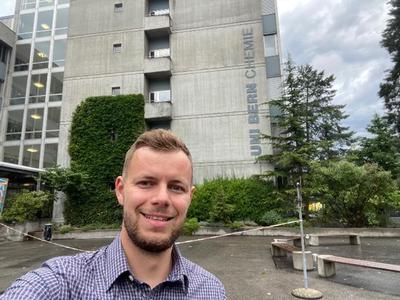
Nestled in the large Reymond group we were given generous space in their chemistry labs and also, very importantly had access to their BSL2 labs for antimicrobial testing within the same Department.
Now perhaps this is good place to consider a bit what an Ambizione grant actually is, and what its purpose should be. Formally it lies between a Postdoc and an Assistant Professor position. So, you are no longer employed by another research group but you are also not employed by the University and are not on a tenure-track or the like. I have heard others call it a ‘Super-Postdoc’ because it is essentially another, extra step on the ladder towards a permanent academic position. Now the generous funding of the grant means that this step will most definitely add some ‘spring’ to your career, but it is still an extra step that perhaps does not need to be there. The general absence of routes towards a more fixed position within host Universities in Switzerland (as far as my knowledge goes) basically guarantees that you will have to move again within the next 4 years. But the Ambizione does buy you 4 years to make yourself more attractive on the relentless academic job market.
One practical dilemma I faced at the very beginning is that, while I now had a whole lot of admin and supervising work to do, it was not really enough to justify being completely out of the lab. So, for the first few months I dabbled in some lab work but was also not really able to focus on it. I think in my mind I felt I was not really that good at lab work and my time would be better spent on reading/thinking-writing and all logistical things. Fortunately for me, two more people joined the group in September 2022. Mirco Scaccaglia had somehow heard of my yet non-existent lab and, for some reason, wanted to join us as part of a very nice scheme in Italy where PhD students are encouraged to spend 6 months abroad in other research groups. For the other member, I again have to thank the supportive Department in Bern that allowed me to advertise for Master students before I even joined, which meant that Sofia Fulgencio, a courageous Biochemistry student, started a (Chemistry) project at the same time. So suddenly we were four in the group, and it became even more difficult to justify my presence in the lab as I really was not productive. Now in retrospect I probably should have thought about a project to do myself in the lab in those first 6-12 months as I was likely not fully optimizing my time. With a group established it was now time to get some science going, which I will not talk much about here. But looking back, a few decisions I made in the first months turned out to be very good, so, in no particular order:
- Thanks to the flexibility of the SNSF funding I could send myself to the Interdisciplinary Course on Antibiotics and Resistance (iCARE, https://www.icarecourse.org/) course in Annecy which is basically a 1-week intensive course designed to get you up to speed on everything antibiotics by the world’s leading experts on the matter. This was an extremely valuable and useful experience for my research and the direction I wanted it to take in the future
- I reached out to researchers around the world who I thought were doing interesting work and asked them for a chat. This is probably my number one advice to anyone in academia. I have had a near perfect record of positive replies from academics of all levels being extremely generous with their time to just hop on a call with a random person that reached out to them. Do it! This led to many collaborations, we learned a whole series of skills and are better equipped as a result
- I also systematically reached out to as many academics within my department as possible and invited them to go for a coffee. Again, everyone was keen and made time and this was a useful way to get to know the department and its workings as well as the other research that goes on (I later did this when I joined York as well and I highly recommend this approach!).
So, the group is up and running, experiments are being done, we are getting first results. Thanks to Mirco joining the group I basically had an extra PhD student for the 6 months (which later were extended to 12 months) which enabled me to, through him, pursue another project I had in my mind (which thanks to his very hard work led a to a very nice Chem. Sci. Paper )
Obviously, after securing the Ambizione my previously frenetic job-application streak came to an abrupt end… 6 months in, my mind slowly drifted towards the future again where I would need to secure the next step. Hence, I decided to update my CV and it just so happens that two fitting positions were advertised at the time and I applied. To my surprise, I was invited to an initial interview for both of them. Long story short, I was made an offer by the University of York and after some back and forth accepted the permanent position as a Lecturer (Assistant Professor equivalent) in Inorganic Chemistry.
Now I don’t think I have been asked any question more frequently over the last 2 years then the ‘why (the heck) did you move from Switzerland to the UK’ question. I am not going to go into implicit assumptions about the two countries/academic systems here, you can read up on that yourself, suffice to say none of them are perfect and each have their pros and cons. As already mentioned, the Ambizione grant started a ticking clock from the beginning. As an Ambizione, I was per design hosted in a larger research group which put some limitations on what we could do. And also by design, the amount of additional funding I could get while having an Ambizione in Switzerland was severely limited (many other SNSF grants explicitly state that you are not eligible to apply if you hold an Ambizione grant). At the time, Switzerland also was in trouble (again) with the EU-Horizon program so the options for me to grow my research group beyond the state it was in were quite limited. Lastly, while I would have loved to stay in Bern as the people and the Department were truly great, there was not a clear path towards a permanent position there available. Being active in the highly interdisciplinary field of medicinal inorganic chemistry is very exciting but it makes it difficult to find positions that are looking for someone like you. For medicinal chemistry positions you are the strange one working with metals and conversely for inorganic chemistry positions you are doing too much biology. Hence, with a competitive academic job market and having the offer of an excellent University in the UK with modern laboratories all the equipment I required for my research AND the possibility to have our very own BSL-2 biolab for bacterial screening was too good of an offer to refuse in the end.
Finally, here are some thoughts I have on the purpose of the Ambizione as a means to bootstrap your independent scientific career. One way in which the SNSF truly renders it a springboard, is the possibility of moving (some of) the funding to another institution, and yes that also means abroad. Now, having gone through this, the paperwork and logistics of this is by no means an easy undertaking BUT it is possible and I have to give kudos to the SNSF for enabling this. So eventually, with the position secured in York we moved the lab to the UK fully at the start of 2025, with the SNSF generously providing another year of funding which was especially needed for Cagri to be able to finish his PhD. This funding now comes to an end with the end of the year. And it has been truly transformative for my career. It was, as intended, a springboard and I currently lead a research group with 10 people which would not be the case without the Ambizione.
So, for me personally, it was great… but, cynically, you could ask, what did the SNSF, and through it, the Swiss Tax Payer get from it? While the Ambizione is a very good springboard, there are not that many landing areas within Switzerland. Academic positions within the country are extremely competitive and there is no safe path towards one, even with an Ambizione. The constantly changing funding schemes of the SNSF also don’t help. While for a while the SNSF Professorships and later Eccellenza Grants where a logical next step, these got diluted with the SNSF Starting Grants that had to be implemented abruptly when Switzerland left the HORIZON funding program (for the second time) resulting in a very uncertain funding landscape in the country. In recent developments a drastic reduction in the SNSF budget by 10% (SNSF Budget Cuts) over each of the next two years will surely make the landscape even more difficult and competitive. Lastly the SNSF, in an understandable effort to stretch available funds, has removed the ability to fund PhD Students with the Ambizione grant from the funding. This in my eyes now truly turns the grant into a Super-Postdoc, where you get a nice chunk of funding to then run your one-person research lab (plus, if you are lucky some Bachelor/Master Students). I was extremely fortunate to get some Master Students and an exchange PhD student in Bern which bootstrapped the group immensely, but that was by no means guaranteed. I also benefitted from an extremely supportive and well-equipped host group that provided so much needed infrastructure and support that probably I could not have found in this way anywhere in Switzerland. In the end, the Ambizione did for me what it was designed to do, and who knows, perhaps one day I will return to Switzerland and the Swiss taxpayer will reap the benefit of their tax-francs. But I am worried about the shrinking budget of the SNSF, the increasing competitiveness of funding and the limited scope of early career starting mechanisms such as the Ambizione and I hope the Swiss Government can course-correct to ensure the leading position in research for Switzerland can be maintained and also supplemented with local talent