Blog, New Paper out in Nature Communications!
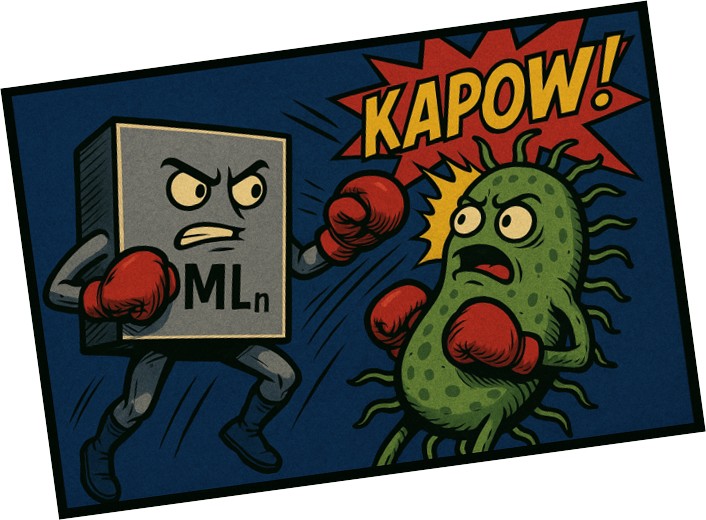
Our newest paper on the Combinatorial Synthesis of triazole-based ligands and their metal complexes is now out in Nature Communications. What follows is an account from David the man himself who helmed the majority of this project from start to finish, enjoy!
When my supervisor Dr. Angelo Frei came into the office three weeks after I began my post-doc with him and asked “what are your opinions on azides?”, my response was distinctly pessimistic. Little did I know how that question would morph into a significant project and dominate the next year of my research!
The idea was, on the face of it, a simple one. Using Meng, Sharpless et al.’s excellent work on SuFEx reagents, it is possible to take almost any primary amine and convert it into an azide in high yield. After generating several azides, we could then do some Click chemistry to generate large libraries of triazole compounds. Triazoles can coordinate to metal centres as ligands, and if we included a pyridine group on the alkyne, we could create large libraries of bidentate ligands at once. It would then be a simple job of coordinating them to some metal centres, some biological testing, and job done.
This is similar to work previously done in our group, called combinatorial chemistry (shameless plug of our Minireview on the topic). I like to think of it as molecular Lego, where building blocks are mixed together and self-assemble into the desired complex. Previously, we have used Schiff base ligands in a one-pot reaction (mixing an amine with an aldehyde in the presence of a metal scaffold) to generate libraries of active metal complexes. While this is good, we wanted to expand our combinatorial approach with the Click chemistry. Although the number of steps synthetic steps is higher than for the Schiff base chemistry, the idea remains the same.
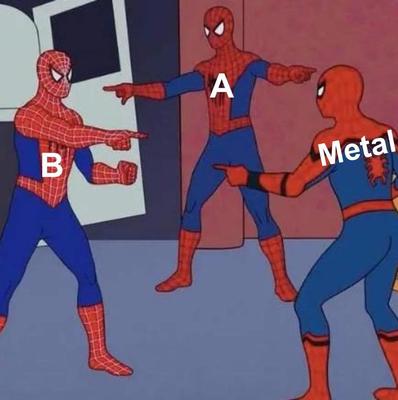
After making one simple pyridine-triazole compound on the combinatorial scale, I then set about throwing it at any metal centre I could lay my hands on. The DMSO solvent the ligand was in proved challenging for some co-ordinations, as it tended to bind with the metal centre instead of the target ligand. But through some judicial heating, co-solvent choices and in some cases, sheer dumb luck, I managed to find conditions to coordinate a simple ligand to several different metal scaffolds.
Time-lapse of a robotic liquid handler dispensing reagents across a 384-well plate.
It is here that I should introduce Wally, our Opentrons O2 robot. Wally was instrumental in the high-throughput synthesis of the Click ligands and metal complexes, although we did go on a bit of a journey together. It turns out that submerging a non-chemically resistant plastic pipette in chemicals doesn’t always end well! But after judicial dismantling, cleaning, and the application of both hammer and blowtorch, we were back on track.
The first stage was to make 96 pyridine-triazole ligands, from 24 amines and 4 alkynes. The diversity of the pyridine-alkynes was a problem, as they tended to be very expensive. Wally made the azides from various stock solutions, then the following day added the rest of the reagents for the click reaction. LC-MS was used to check conversion, and at this point it became apparent that some amines were not at all suitable for the click reaction! I replaced these with other amines, and made another library, which this time worked well. Storing the amines resulted in some unexpected, and for the first time in my life, very unwelcome single crystals forming (from DMSO!). As this would massively affect the concentrations of ligand in solution, with tears in my eyes I sonicated the individual vials to pulverize the beautiful crystals. This would allow for mixing and accurate dispensing of the ligands by the robot. In one go, Wally dispensed the ligands into 6 separate plates and added the metal scaffolds ready for complexation. After heating, shaking and getting LC-MS data for the entire libraries, we had several hundred new metal complexes to play with.
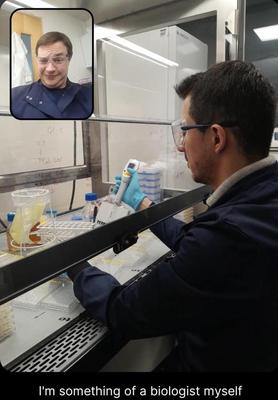
At this point, it is worth mentioning that I am an inorganic chemist by training, very at home with Schlenk lines, inert atmospheres, and high vacuums. So it was with some trepidation that I picked up my first petri dish and some unpleasant smelling growth media and got to work. I must thank Çağrı Özsan, who was my mentor in all things microbiology and worked with me on testing all these compounds. Together, we screened everything (ligands, metal scaffolds and complexes) for antibacterial activity against Gram positive bacteria and the much-harder-to-kill Gram negative bacteria, with varying success. One particular disappointment was the libraries based off ruthenium metals, where similar compounds have been shown to be highly active. But the high activity of the iridum and rhenium libraries was very welcome indeed. We did full minimum inhibitory concentration (MIC) assays with these two libraries to determine just how good they were, and the results were very promising indeed!
Although it is good to know that compounds can kill bacteria, the flip-side of the coin is their toxicity towards healthy cells. Previous work in our group and others has shown that iridium and rhenium compounds can be really toxic towards healthy cells (in some cases more toxic than the controls!), even if they are very effective antibiotics. The crucial measure is the therapeutic index (TI), which is the ratio of how effective a drug is compared to its toxicity. For reference, paracetamol has a TI of 8 (!), while ideally any potentially interesting compound should have a TI higher than 10.
This is where the rugby aficionado, motorbike riding and all-round gem Dr. Athi Welsh enters the scene. In the three months that it had taken me to develop the project to this point, Athi had set up and developed assays in a cell lab to do toxicity testing of compounds against healthy human cells. We decided on using a single-dose response assay to test several hundred compounds toxicity, which coupled with the antibacterial activity should give an idea of which compounds were worth pursuing. This gave us six potential compounds that had relatively low toxicity and high activity against Gram positive bacteria. These were made and purified on a larger scale for retesting to confirm that the data from the crude reaction mixtures was correct. The iridium compounds behaved nicely during synthesis and purification, but the rhenium compounds were a bit more tricky. The purifications involved columning metal complexes, which felt very wrong for a traditional chemist, but to my surprise they all survived. For all complexes, we found a significant increase in both their activity and toxicity against both healthy cells and bacteria. This was expected for the activity, and although the toxicity was higher than anticipated, the therapeutic index of the compounds meant that 5 of the 6 had a TI higher than 10. One iridium compound was not very toxic at all, giving a TI higher than 50, which was good indeed! We tested all the compounds against several different Gram-positive bacteria to find out how broad-spectrum they were, and their activity was generally high.
Although finding new antibiotics is the core mission of our group, one of the things that I was interested in from my PhD days was the potential catalytic applications of all these compounds. Similar species to the ruthenium and iridium compounds have been used in transfer hydrogenation reactions as catalysts, and I wondered whether we could use our libraries to screen for catalytically active compounds. This had a biological dimension too, as catalytically active compounds could be used to uncage or activate inert prodrugs in cells to achieve antibiotic effects, as demonstrated by Weng et al. We tested both the ruthenium and iridium libraries in two different transfer hydrogenation assays, with a coumarin azide substrate (the product of which fluoresced) and a harmaline substrate (with a distinctive UV-Vis absorbance). These were chosen so that reaction monitoring could be done in a plate reader, allowing us to get kinetics for 96 reactions at once! Iridium compounds were more active in both assays than the ruthenium compounds, and two of these were re-synthesised and tested in the same catalytic assays. Only one of the compounds turned out to be highly active in both assays, which speaks to the complexity of these reactions in terms of a sweet spot of electron donating and withdrawing ligand effects.
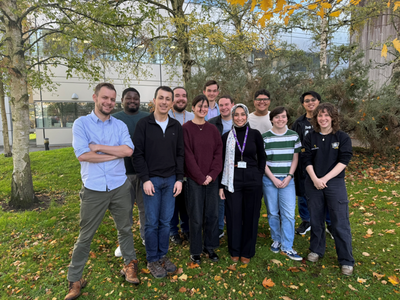
This project was the first big undertaking that I had done since finishing my PhD, and it would be remis of me not to say a big thank you to Angelo, Çağrı and Athi. This work was taking place when Angelo had just moved to the University of York from Switzerland, and when I started my postdoc my first job was to unpack all the glassware that he had brought! Together, we all set up a dedicated microbiology lab in the chemistry department, developed cell-based assays for toxicity studies and founded a new home for the FreiLab. There have been many problems along the way, from bacteria misbehaving to auto-column shenanigans, solubility problems to running out of stock solutions. But through all of it, my friends and colleagues have been a rock, and without them this work would not have been possible. It has been a massive learning curve for me personally, and I could not be prouder of what we have achieved with limited resources and in such a short space of time. A true team effort all round, and I hope that this work leads to other people trying combinatorial chemistry as a high-throughput screening tool to tackle some of the problems we face as a society.
And to finish, here is a summary of the work in the form of a Shakespearean Sonnet that I wrote (with help from other group members) for a conference at York:
Shall I compare thee to Vancomycin,
Or let thee fight Polymyxin rent E. coli
For metal-clad molecular knights shall win
An age-old battle, joined with a fearsome cry.
Assembled through machinations anew
From azides, amines and metals galore.
In conditions mild, and easy to redo
Tested in assays, though solubility was poor.
And when through anguish there was revealed
A fellowship of souls prepared to take
A stand against bacteria foul, they sealed
A triumphant victory for antimicrobial’s sake.
For though our brave heroes toxicity may alarm,
Their power could well save us all from greater harm.
David